
Well, I didn’t really want the video ^ to be the first thing you see in this newsletter, but with their new “recording studio” function, it seems automatic. I can’t insert either a photo or text above the video while using this function. Ugh. Maybe it will be my first and last time using it. Substack’s driving me a little crazy lately, to be honest. They keep inventing ways to persuade authors to sell themselves in particular ways I find de-humanizing. I’m not a product or a brand; I am a poet, seeking to share some of my original poetry with anyone who is interested, and adding notes/audio recordings/videos that I hope make poetry that much more hospitable. That’s the goal. Are you with me?
Anyways, today’s poem ~ it’s one of my Puzzlement Poems I’ve been working on in the last few weeks. It came out of a class I’ve been taking for the month of May with the poet Scott Cairns. The class has churned a lot of poems out of me, for which I’m thankful.
Scott encouraged us to find our “puzzlements” in the Scriptures and write from there. So who better than Melchizedek when it comes to puzzlement?
Here’s the audio of me reading the poem, if you like:
Melchizedek
Genesis 14:18 ~ Then Melchizedek king of Salem brought out bread and wine.


Let the logic of Melchizedek gratify
the mystic. Music’s in it:
God-Adam-Seth-Noah-Shem-Abram

—sharp note sings Melchizedek. This king
of kings come to the valley, King of Peace
chanting victory with bread and wine,

King of Righteousness whose odd
crescendo turns the tithe into a banner
for our song to follow after. Hear the order

in the Scriptures—ancient triptychs
of deliverance—how his cadence holds true:
heavenandearth holyholyholy allthingsnew.

The LORD has sworn it. Melchizedek—
eternal blesser of the blessing-bearer
—verses rise from your riddled line

Christ bellows into time.
In case you’re wondering, here are the Scripture references for this king/priest/pre-incarnate Christ figure:
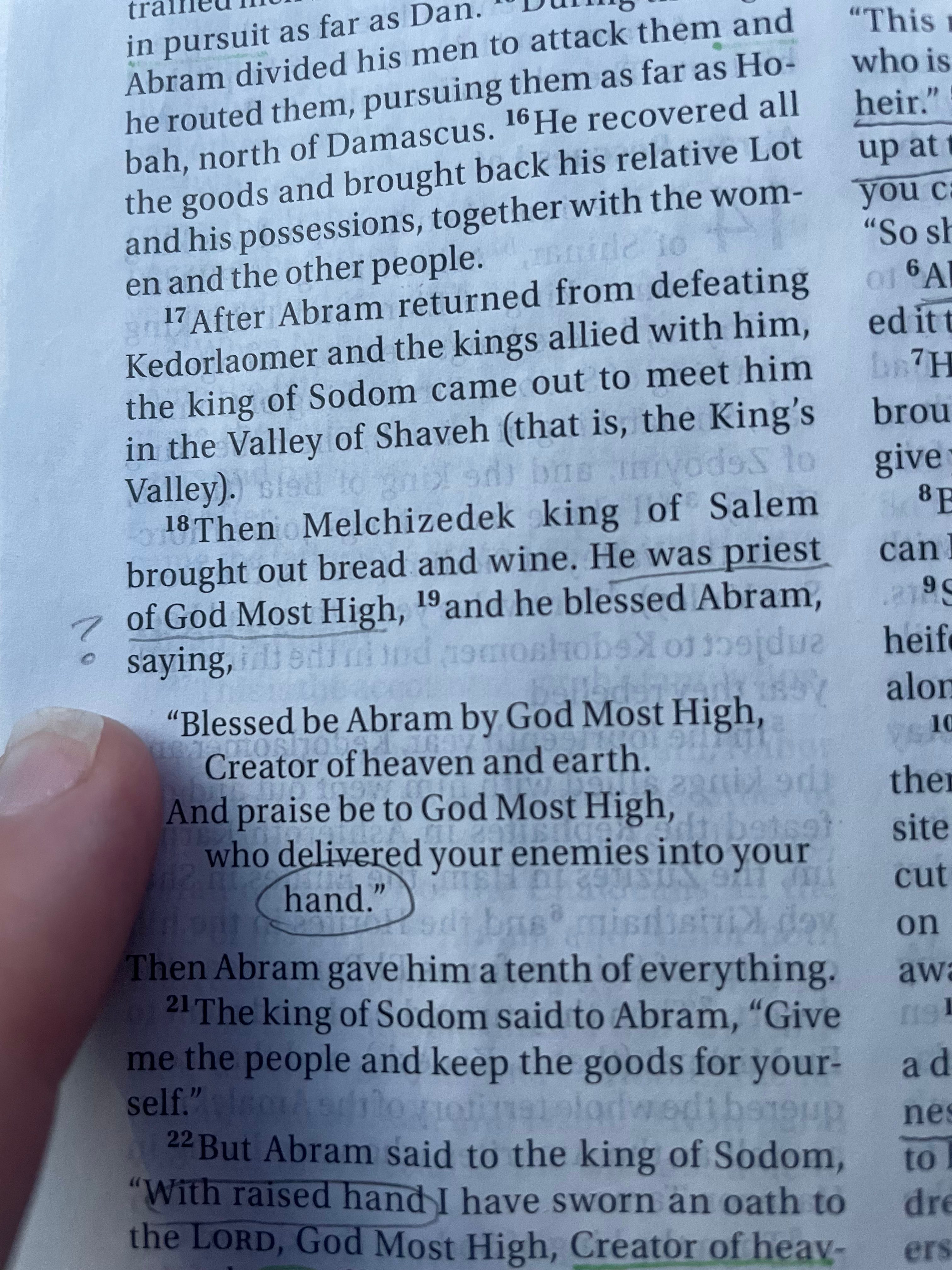
Genesis 14:17-20 ~
“After Abram returned from defeating Kedorlaomer and the kings allied with him, the king of Sodom came out to meet him in the Valley of Shaveh (that is, the King’s Valley).
Then Melchizedek king of Salem brought out bread and wine. He was priest of God Most High, and he blessed Abram, saying,
‘Blessed be Abram by God Most High, Creator of heaven and earth. And praise be to God Most High, who delivered your enemies into your hand.’
Then Abram gave him a tenth of everything.”
okaaaaaaaay, pretty strange. Then we get this in Psalm 110:4 (a Psalm of David)~
“The LORD has sworn and will not change his mind: ‘You are a priest forever, in the order of Melchizedek.’”
Definitely go and read all of Psalm 110 for more context if you’re interested, it’s a very short psalm, only 7 verses.
And then, when we come to Hebrews, there is SO MUCH about Melchizedek, as in 3 chapters’ worth! They’re not entirely about Mel, but a lot seems to hang on him.
Starting in Hebrews 5:5-6~
“…Christ did not take on himself the glory of becoming a high priest. But God said to him, ‘You are my Son; today I have become your Father.’ And he says in another place, ‘You are a priest forever, in the order of Melchizedek.’”
…and the section ends with the writer saying this of Jesus, in vs 9-11~
“…once made perfect, he became the source of eternal salvation for all who obey him, and was designated by God to be high priest in the order of Melchizedek. We have much to say about this, but it is hard to make it clear to you because you no longer try to understand.”
Have you ever noticed that before? Right after the writer mentions Melchizedek, we read, “We have much to say about this… but you won’t get it (my paraphrase).” WE COULD HAVE HEARD MORE ABOUT MELCHIZEDEK! But alas, we are, like the first readers of this letter, living on milk and not mature enough for solid food. The logic of Melchizedek is solid food, y’all.
Then there’s a whole chapter (6) about things seemingly unrelated to Melchizedek, until the last verse, where, again, our attention is brought back, in 6:19-20~
“We have this hope as an anchor for the soul, firm and secure. It enters the inner sanctuary behind the curtain, where our forerunner, Jesus, has entered on our behalf. He has become a high priest forever, in the order of Melchizedek.”
Alright, NOW we’re in chapter 7, which is pretty much all about Melchizedek. His name is explained, his greatness is honored, and a strange (to me at least) explanation of the tithe is given us, about how the future order of priests, the Levites, were technically still in the body of Abraham at this point, and yet, instead of that line receiving tribute from Melchizedek (which is how it would later work with regard to the Levites, collecting a tenth from the people), it went the other way around (!) and Abram gave a tenth of all he had to Melchizedek, who, get this — we’re told was
“…without father or mother, without genealogy, without beginning of days or end of life, resembling the Son of God, he remains a priest forever.” ~ Hebrews 7:3
Then the conversation turns to comparing and contrasting Aaron’s line with Melchizedek’s, and how Jesus came from the tribe of Judah, and answers the question — on what basis does Jesus become a high priest?—
“…on the basis of the power of an indestructible life. For it is declared: ‘You are a priest forever, in the order of Melchizedek.’” ~ Hebrews 7:16-17
That is the 5th time, by my reckoning, that the writer to the Hebrews brings up that verse from Psalm 110, in a matter of three and a half chapters. And it gets quoted again in 7:21, though lacking the final phrase, ‘in the order of Melchizedek.’
Are you sufficiently puzzled? Or have you perfectly figured this guy out?
Here’s the best part of the music of this mystery, beloveds: Jesus “truly meets our need” (Hebrews 7:26) —
and this he “bellows into time,” thanks be to God.
Further up & further in,
Anna
p.s. Paid subscribers, God bless you, I’m going to share an extra poem with you this week, one cheekily titled, “After Reading Ecclesiastes through Lent, I hear Scott Cairns Make a Pun About the Phrase Coming to Terms” — yep, that’s the title of the poem.


